
Friday, April 27, 2012

Tuesday, April 24, 2012
Updated Motor Mount
After determining that our previous design for the motor mount would not be strong enough to withstand the total torque, we redesigned the mount as pictured below. The single-piece design mounts at three points on the robot's lower platform and connects in the middle. It will be made of bent acrylic that wraps around the motor and attaches using the four mounting screws surrounding the shaft.


The perfect stepper motor
http://www.pololu.com/catalog/product/1209


This hybrid bipolar stepping motor has a 1.8° step angle (200 steps/revolution). Each phase draws 500 mA at 10 V, allowing for a holding torque of 1000 g-cm (14 oz-in).


This hybrid bipolar stepping motor has a 1.8° step angle (200 steps/revolution). Each phase draws 500 mA at 10 V, allowing for a holding torque of 1000 g-cm (14 oz-in).
Overview
This hybrid bipolar stepping motor has a 1.8° step angle (200 steps/revolution). Each phase draws 1000 mA at 2.7 V, allowing for a holding torque of 1400 g-cm (20 oz-in). The motor has four color-coded wires terminated with bare leads. Our 5mm universal mounting hub can be used to mount objects on the stepper motor’s 5mm-diameter output shaft.
Specifications
- Size: 35 mm square x 36 mm, not including the shaft (NEMA 14)
- Weight: 180 g (6 oz)
- Shaft diameter: 5 mm
- Steps per revolution: 200
- Current rating: 1000 mA per coil
- Voltage rating: 2.7 V
- Resistance: 2.7 Ohm per coil
- Holding torque: 1400 g-cm (20 oz-in)
- Inductance: 4.3 mH per coil
- Lead length: 12 in
These specs and pictures are straight off of the Pololu website. Our team thinks that this motor is perfect for our robots drive motors because of it's really high torque at low speeds. We think that this is one of the most important features in selecting a motor for our robot because we are concerned about the robot tipping over more when it has to make small adjustments because momentum will not be available to help keep the robot stable.
Tuesday, April 17, 2012
finding the right ball for the job
A very large component of our ball balancing robot is the the physical ball. Below is our primary list of constraints for the robot's ball:
- We need to select a ball that will be able to support the weight of the robot without contorting too much.
- The ball needs to have enough traction that the slippage will not become a problem with the hi torque motors on smooth surfaces
- The ball's surface needs to be smooth enough that the omni wheel does not skip on seams of the ball.
Basic Design
Below are screen shots of the basic mechanical design of the robot.

Side View

Bottom View

Top View
Monday, April 16, 2012
Gyroscope and Accelerometers
For this robot to be able to balance the most important component to this task is not the body of the robot but the data that is drawn from the robot. It is like a body without a brain it serves no purpose with out the ability to function. These two parts to the robot will be able to extract information sending it though the micro chip and later processing it.
Accelerometer:
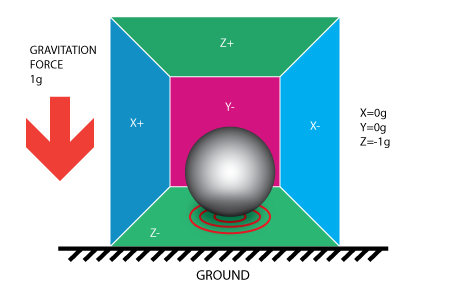
An accelerometer is a device that has the ability to measure and calculate accelerations in micro-movements. With in this device it is broken down to a simple structure that can detect three dimensions of acceleration. It is composed of springs holding together a centerpiece. When an acceleration is felt, a certain amount of voltage is generated though kinetic energy. The accelerometer has read and record the acceleration felt by the device.

Gyroscope:
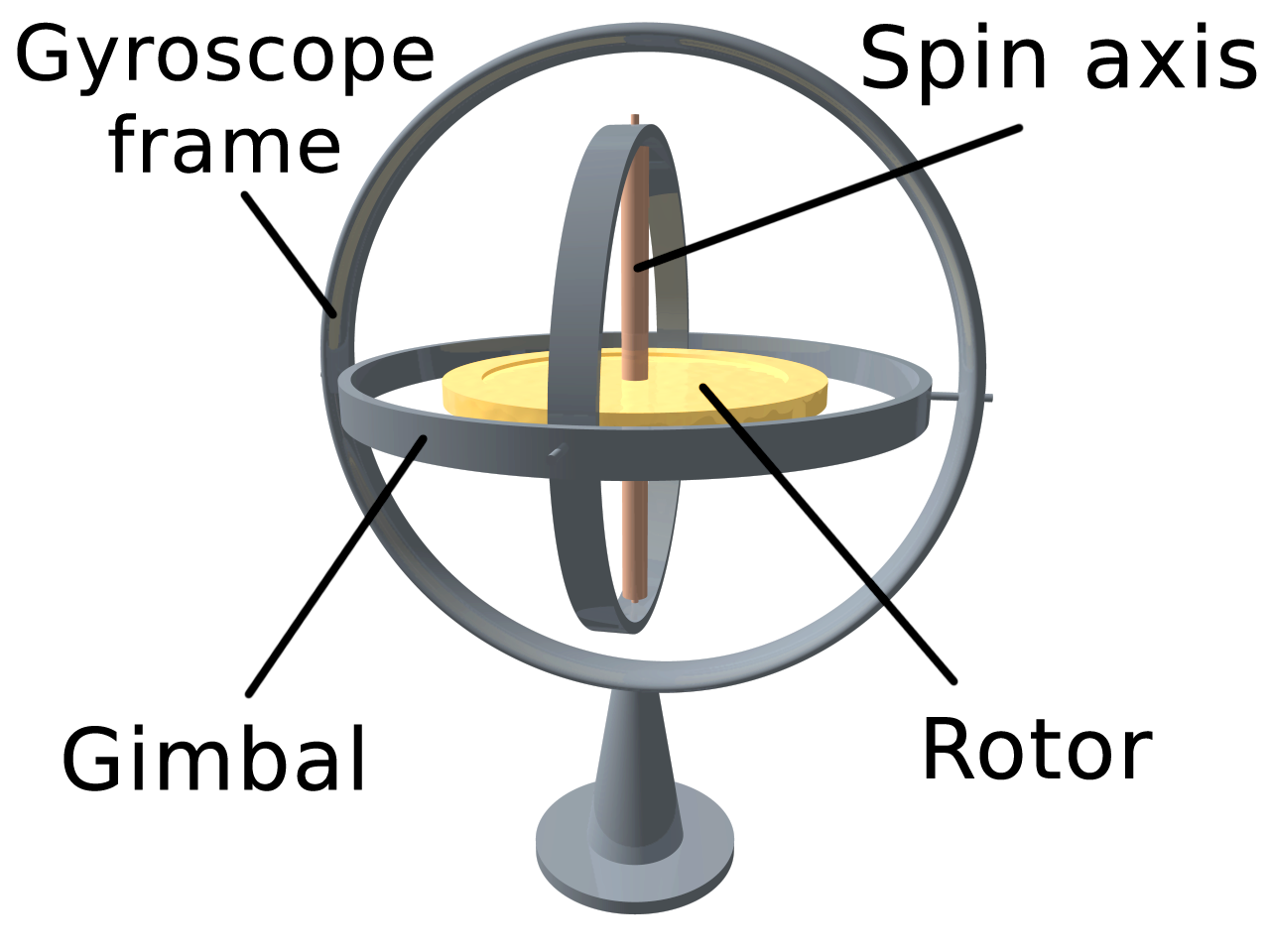
A gyroscope is a device that has the ability to measure and calculate angular acceleration based on its orientation. The angular acceleration can be calculated due to the structure of the gyroscope. Similar to the accelerometer volts are read when the internal parts of the gyroscope are displaced. However the structure varies from a basic accelerometer. There are disk and wheels whose axis is free to take up any orientation. For example if a force is felt on the positive x axis then the disk will rotate clockwise. This is important because due to the object that this robot will be balancing on, there are endless possibilities of motion.

The issue of the Accelerometer is that it lacks the precision and data that a gyroscope has in addition the gyroscope has an issue with calibration. By combining these two devices one could eliminate the issue of accuracy in data.
Accelerometer:
An accelerometer is a device that has the ability to measure and calculate accelerations in micro-movements. With in this device it is broken down to a simple structure that can detect three dimensions of acceleration. It is composed of springs holding together a centerpiece. When an acceleration is felt, a certain amount of voltage is generated though kinetic energy. The accelerometer has read and record the acceleration felt by the device.
Gyroscope:
A gyroscope is a device that has the ability to measure and calculate angular acceleration based on its orientation. The angular acceleration can be calculated due to the structure of the gyroscope. Similar to the accelerometer volts are read when the internal parts of the gyroscope are displaced. However the structure varies from a basic accelerometer. There are disk and wheels whose axis is free to take up any orientation. For example if a force is felt on the positive x axis then the disk will rotate clockwise. This is important because due to the object that this robot will be balancing on, there are endless possibilities of motion.
The issue of the Accelerometer is that it lacks the precision and data that a gyroscope has in addition the gyroscope has an issue with calibration. By combining these two devices one could eliminate the issue of accuracy in data.
Wednesday, April 11, 2012


Subscribe to:
Posts (Atom)